Sensitive Teeth & Gums
Early caries treatment: a drill‑free option for sensitive teeth
A peptide-based, drill‑free treatment for early decay shows promise. Here’s what it means for sensitivity, what the evidence says and what to ask at your check‑up.
By The Smile Editorial Team
Published · 6 min read

Quick answerA dentist‑applied peptide liquid for very early tooth decay (no hole yet) has encouraging evidence for keeping lesions stable. It’s a private option in the UK and does not replace daily fluoride care or fillings when a cavity has formed.
Not medical advice. General information only. We don't diagnose or treat. Never try dental treatment at home. Always see a dentist about symptoms.
A drill‑free, dentist‑applied liquid for the earliest stage of tooth decay is gaining attention as a way to stabilise weak spots before they turn into cavities. For people who feel twinges from cold or sweets, the idea of reinforcing enamel without injections or drilling is understandably appealing.
Researchers have reported promising results for a self‑assembling peptide (known as P11‑4) that is painted onto non‑cavitated lesions, typically between teeth, to encourage minerals to reintegrate into enamel. We look at how it works, how strong the evidence is, what it might cost privately, and how it fits with UK advice on sensitive teeth and decay prevention.
What happened
Recent evidence has focused on whether applying a peptide solution to early enamel decay can halt or slow progression. A 2023 systematic review and meta‑analysis in the Journal of the American Dental Association concluded that the P11‑4 approach can improve arrest rates and reduce lesion progression compared with control treatments.
A separate 2023 retrospective study from a public paediatric dental clinic in Chur, Switzerland, followed 219 adolescents with 405 interproximal (between‑tooth) lesions for up to 5.5 years after a single peptide application. The authors reported a 93% clinical success rate, with around 90% of lesions staying non‑cavitated during follow‑up.
That same study also observed regression of lesions in roughly 37% to 40% of cases, depending on starting severity, suggesting some weak spots appeared smaller on follow‑up images. The authors cautioned that radiographs are not highly sensitive for early mineral changes, so any apparent improvement should be interpreted carefully.
Laboratory work published in 2016 reported the peptide could penetrate deeper into demineralised enamel than fluoride varnish in a bench‑top model. In‑vitro results like these help explain the mechanism, but they do not guarantee identical effects in the mouth.
Clinically, dentists describe the procedure as quick and additive to a routine visit when appropriate: clean the surface, etch briefly to open enamel pores, then apply the liquid and allow it to soak. Many practices place it at the end of a check‑up when a suitable lesion is identified.
Where diagnosis and care plans are in place, dental hygienists and dental therapists may deliver this within their scope and training, typically under agreed practice protocols. Suitability depends on the lesion being confined to enamel with no broken surface.
Private fees vary by clinic. One practice has reported charging around £120–£150 to treat up to two early lesions in a visit, noting the product outlay is a small part of the overall fee. These figures are illustrative only, and UK prices differ by region and workflow.
The background
Early caries is a softening of enamel from frequent sugar‑acid attacks, often starting between teeth where plaque lingers. At this stage the surface can look chalky or show a shadow on X‑rays, but no hole has formed. Symptoms may include mild, short‑lived sensitivity to cold or sweet foods.
Because the surface is intact, enamel can sometimes be rehardened. UK guidance in Delivering Better Oral Health emphasises prevention first: consistent fluoride toothpaste use, tailored fluoride varnish, diet advice to reduce sugary frequency, and effective plaque removal, especially between teeth.
Other micro‑invasive options already used in UK practice include resin infiltration for certain smooth‑surface and proximal lesions, and, in selected cases, silver diamine fluoride to arrest decay. The peptide approach sits alongside these as another way to tip the balance towards remineralisation.
The peptide is designed to self‑assemble within the lesion body and act as a scaffold for calcium and phosphate from saliva to crystallise as hydroxyapatite. In plain English, it aims to give minerals something to stick to so the weak area can reharden from within.
The NHS does not routinely list peptide remineralisation as a treatment band, so patients are likely to encounter it as a private option. If you are offered it, you should still expect a personalised prevention plan covering fluoride, diet and cleaning habits, not a one‑off fix.
Sensitive teeth have several possible causes besides early decay, including gum recession exposing dentine and enamel wear from acids or brushing technique. Our explainer on sensitive teeth triggers in endurance sport shows how habits and environments can add up.
Daily basics remain crucial. Spitting, not rinsing, after brushing keeps fluoride working for longer; see our guide on why rinsing after brushing can wash away fluoride. Interdental cleaning is essential because many early lesions start between teeth; our piece on why flossing still matters even with “smart” brushes explains the difference gadgets can and can’t make.
If a lesion has progressed to a cavity, reinforcement alone will not suffice and a restorative treatment will be needed. Persistent toothache, swelling, mouth ulcers that don’t heal, or loose teeth warrant a prompt dental assessment; sudden swelling that affects breathing or swallowing is a medical emergency (call 999 or go to A&E).
What people are saying
Researchers highlight several strengths of the peptide approach: it is micro‑invasive, can be added to routine visits, and targets the lesion body rather than just the surface. The 2023 JADA meta‑analysis found better arrest and fewer cavities forming compared with controls in early lesions.
Limitations matter too. The Swiss clinic study was retrospective and not randomised, so unmeasured factors could influence outcomes. Definitions of “success” vary across studies, and X‑rays are imperfect for tracking small mineral shifts in early enamel.
Not every early lesion progresses to a cavity, so apparent stability over years is encouraging but not definitive proof of benefit in every case. Well‑designed randomised trials in UK settings and cost‑effectiveness analyses would help dentists judge where this fits best alongside existing prevention.
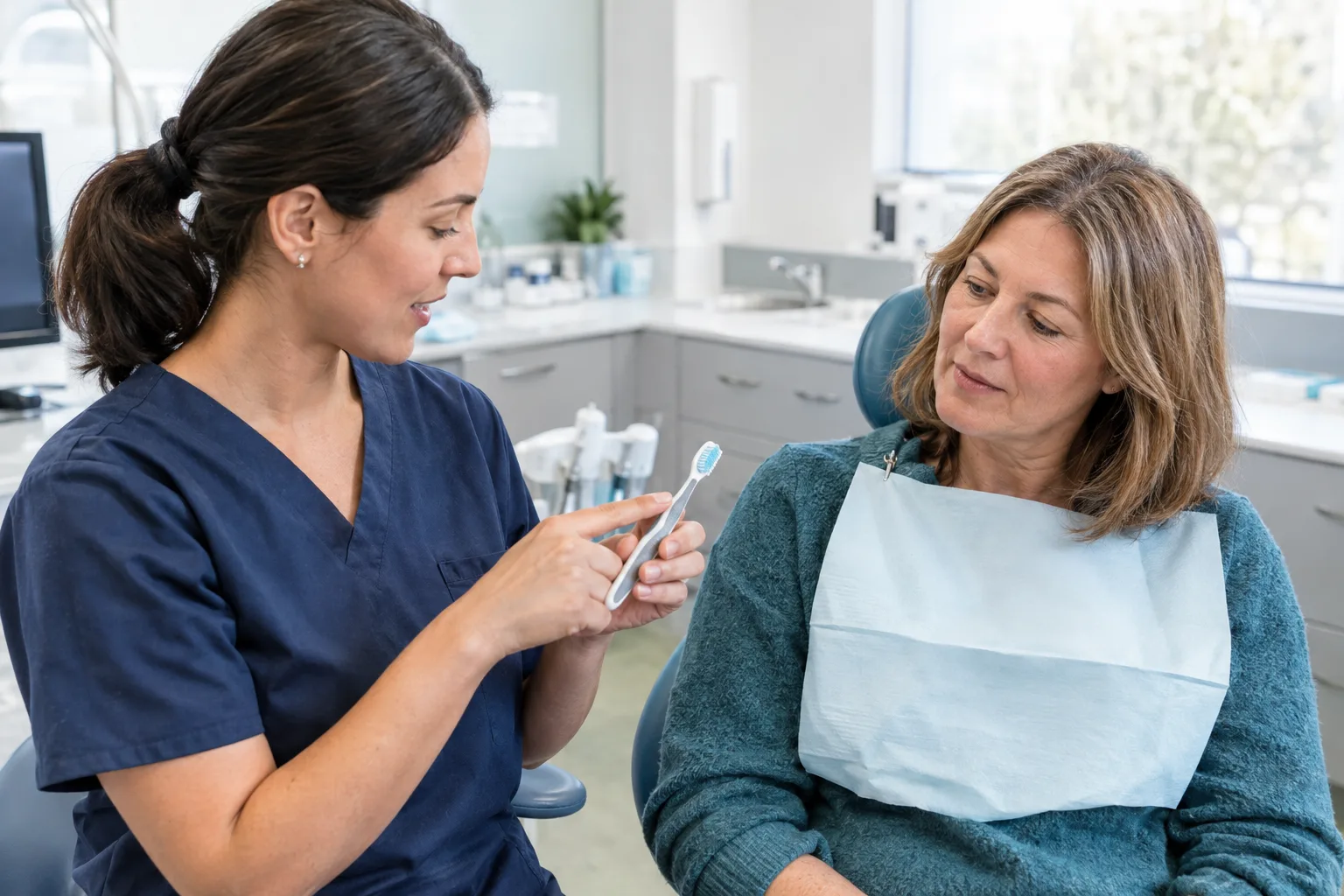
From the chairside perspective, teams report that showing patients photographs and bitewing X‑rays helps explain findings and choices. Some practices describe integrating the application into the end of a check‑up, which can reduce extra bookings when a suitable lesion is spotted.
On costs, individual clinics set private fees based on time, materials and overheads. If you’re offered this treatment, you can ask for an itemised estimate, what follow‑up is included, and how it compares with alternatives. Our explainer on what private dental prices may mean for you covers common questions.
Patients have rights if they’re unhappy with private care. Practices should have a clear complaints process and signpost to independent redress if needed; see our guide to your options when private dental care goes wrong.
What happens next
If you’re told you have “early decay” or “a white spot” without a hole, ask your dentist: is the surface intact, what are my options, and how do prevention steps fit in? For a peptide application, check suitability, expected benefits, risks, costs, and how success will be reviewed.
For now, UK prevention guidance is unchanged: twice‑daily fluoride toothpaste, tailored fluoride varnish, sugar‑smart choices, and thorough plaque control remain the foundation. A peptide treatment may be an extra tool for some early lesions, not a substitute for daily care.
Regular check‑ups help pick up weak spots earlier, when micro‑invasive care is most feasible. Interdental cleaning, fluoride exposure and diet remain the biggest levers for avoiding sensitivity and future fillings, whatever new materials arrive in the surgery.
Researchers are likely to publish more real‑world and trial data over the next few years, including comparisons with resin infiltration and high‑fluoride protocols. If UK studies confirm benefits and value for money, wider uptake could follow, but for now availability is mainly private and practice‑dependent.
Why this matters
Early enamel decay can cause sensitivity and, left unchecked, may progress to a cavity. A peptide‑based application offers a potential drill‑free option for suitable early lesions, but it sits alongside—not instead of—fluoride, diet and cleaning. If you’re offered it privately, ask about evidence, costs, and alternatives, and make sure your prevention plan covers interdental cleaning and fluoride use. Our guide on why flossing still matters even with “smart” brushes can help you focus on the basics that protect enamel every day.
Common questions
- what is the drill‑free peptide treatment for early tooth decay
- It’s a dentist‑applied self‑assembling peptide (P11‑4) painted onto intact early lesions to encourage minerals from saliva to reharden enamel.
- does this early caries treatment help with sensitive teeth
- It may reduce sensitivity linked to early enamel demineralisation by reinforcing weak spots, but results vary and other causes of sensitivity may need different care.
- is the peptide remineralisation treatment available on the nhs
- It’s mainly offered privately in the UK. NHS care focuses on prevention with fluoride, diet advice and micro‑invasive options already in routine use.
- how long does the treatment take and who can provide it
- Application is short and often added to a routine visit. Dentists provide it, and hygienists or therapists may deliver it within their training and scope.
- how much does this early caries treatment cost privately in the uk
- Fees vary widely. One practice reported £120–£150 for up to two early lesions in a visit, but prices depend on clinic, time and follow‑up.
- does this replace fluoride varnish or resin infiltration
- No. It’s an additional option for selected early lesions. UK guidance still prioritises fluoride, diet changes and plaque control, with other micro‑invasive choices available.
- can it treat a hole or cavity that has already formed
- No. It is for non‑cavitated enamel lesions only. If a cavity is present, a restorative treatment is usually needed after professional assessment.
- what are the downsides or limits of the evidence
- Some studies are retrospective and X‑rays can miss small mineral changes. More UK trials and cost‑effectiveness data would help clarify where it adds most value.
Sources
This article was written by The Smile using the sources listed above. Last updated 20 November 2026. It does not name or recommend brands; sponsorship appears only in clearly labelled panels.